January
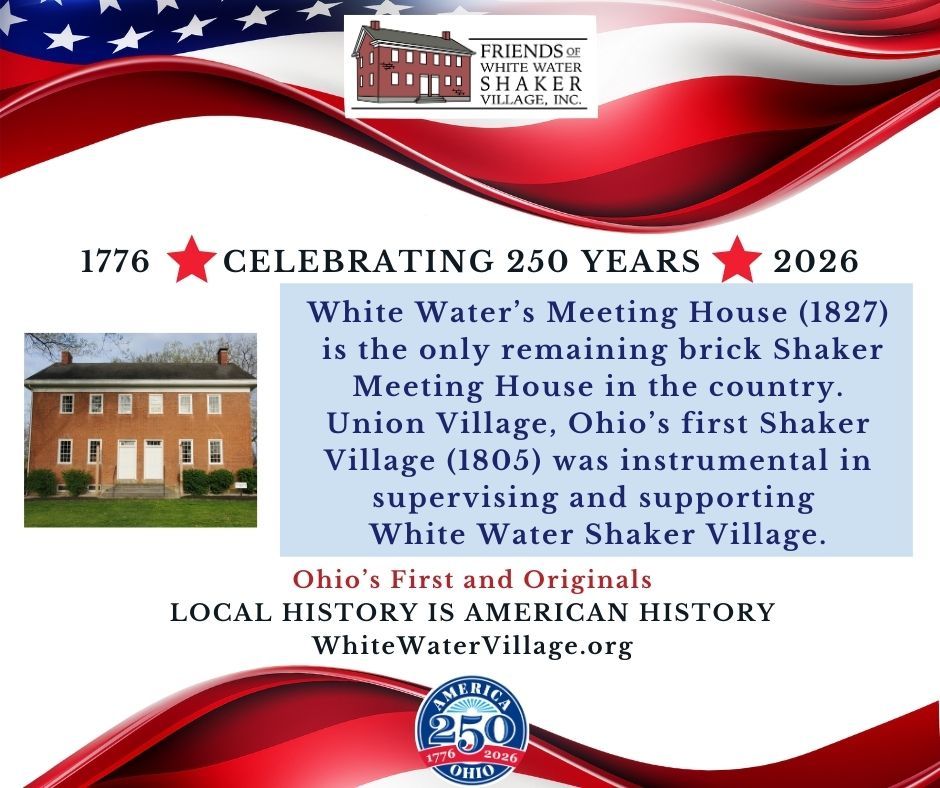
America 250 - Ohio's January theme is Ohio's Firsts and Originals.
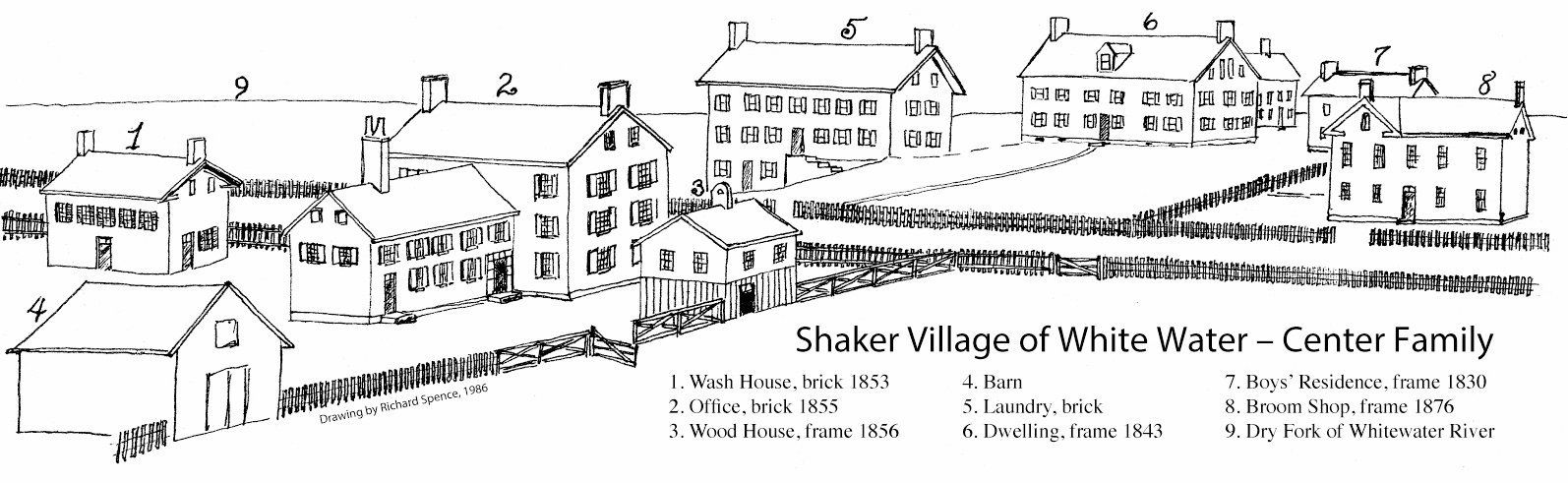
White Water's Meeting House is the only brick Shaker meeting house built in Ohio and the only one of the two brick Shaker meeting houses built in America remaining. The other brick meeting house was at South Union Shaker Village in Auburn, Kentucky.
According to the Millennial Laws (first written in 1821), Shaker meeting houses were to be built of wood, painted white, and have two separate entrances, with the door on the left for men (Brothers or Brethren) and the door on the right used by the women (Sisters).
February
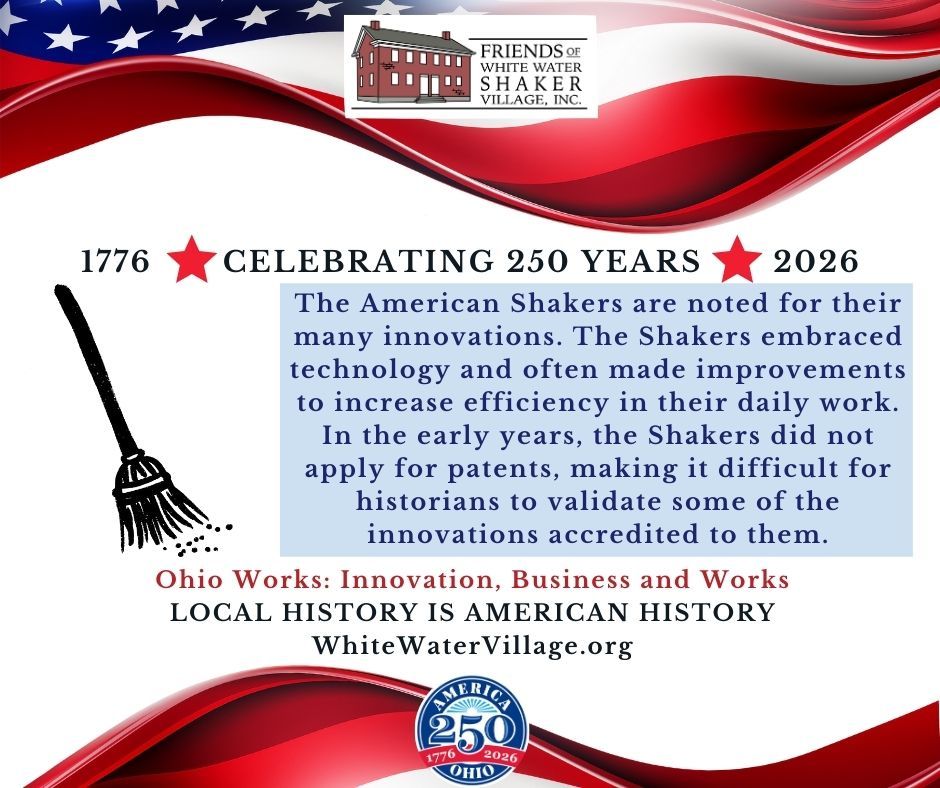
The Shakers are known to have innovated many tools, machines, goods, and practices throughout the years. When completing tasks for a large group of people living together, finding ways to streamline the processes would prove invaluable. There were many skilled craftsmen and women living in the Shaker communities throughout America.
Elizabeth Yuko recently wrote an article for the History Channel about some Shaker innovations. Make sure to follow the links within “How the Shakers Improved These 4 Everyday Objects” (https://www.history.com/art.../shaker-innovations-inventions) to see some of the artifacts and learn more.
In the book The Shakers of White Water, Ohio, 1823-1916, two successful innovations are noted as having occurred at White Water – a steam-powered grindstone used to sharpen shears and an apparatus for steaming meal and bran for cow feed (Innis, Jr. & Sakmyster, 2014, p. 200).
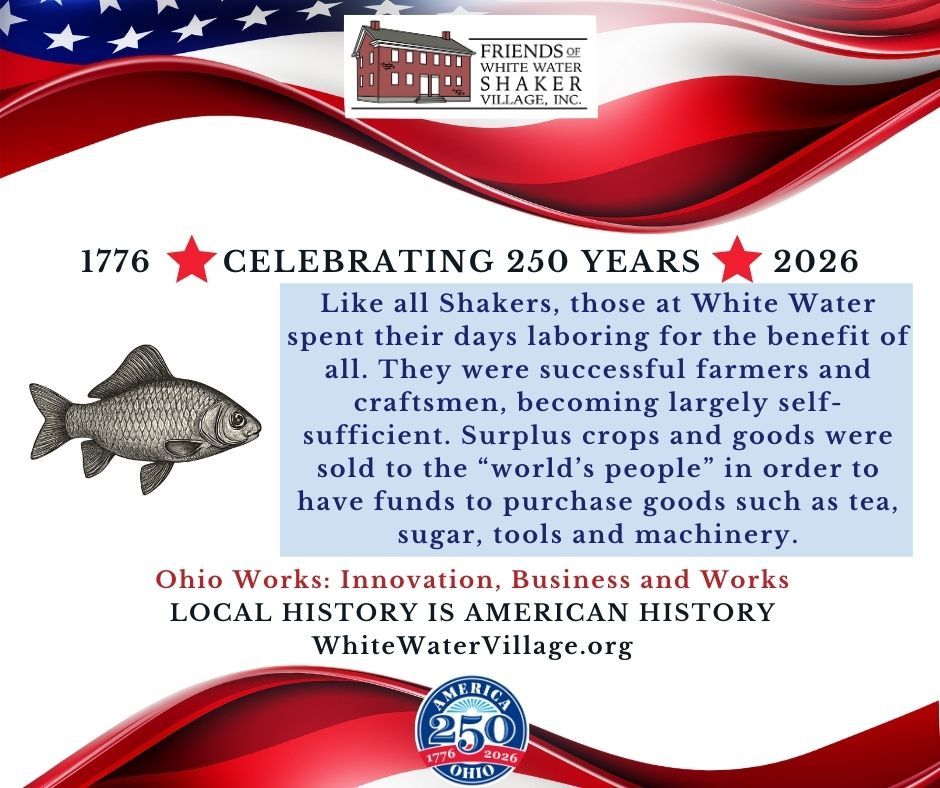
An unusual & innovative economic venture that took place at White Water in the 1880s was fish farming (Innis, Jr. & Sakmyster, 2014, p. 201). Charles Sturr created a system of connected ponds on six acres and stocked them with 10 fish in 1881. By 1884, the ponds were reported to contain at least 40,000 fish, mostly German carp. Sturr assisted some local farmers in setting up their own fish ponds and began selling fish for stocking. By the late 1880s, yearly income reached $350, which has an approximate value of $11,000 today.
Innis, Jr., J.R. & Sakmyster, T. (Eds.). 2014. The Shakers of White Water, Ohio, 1823-1916. Richard W. Couper Press.
March
America 250 - Ohio's March theme is Ohio Entertains: Music, Entertainment & Movies. (Part 2)
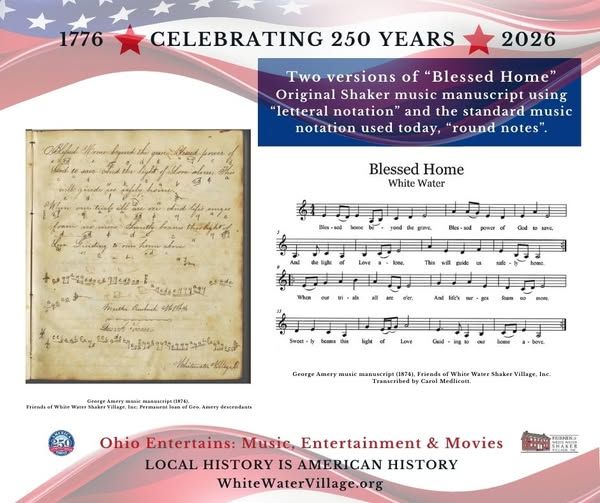
Carol Medlicott graciously shared this explanation of the Shakers’ unique music notation system – called “letteral notation”.
“Shakers have always created their own music and song. In the early years of the movement, oral tradition was sufficient for transmitting tunes of the many hymns and songs. As Shaker communities multiplied, oral tradition became insufficient. Many early Shakers possessed musical knowledge from their pre-Shaker lives. In New England of the late 18th and early 19th centuries, shape-note notation was widely used in choral singing. A very old tradition with roots in medieval Europe, it involved the use of four shaped noteheads on a five-line staff — a triangle, an oval, a rectangle, and a diamond — representing the intervals of the scale. Use of shape-note notation was popular among a wide array of religious denominations, as well as in secular singing. Many early Shaker converts were familiar with it. Consequently, many early Shakers used shape-notes to write down their own original tunes in manuscripts. Early Shakers sometimes used conventional round-note notation, too. But by the 1820s, Shakers began to innovate their own original music notation system. This reflected the general Shaker impulse to reject mainstream cultural practices in favor of their own unique alternatives. The Shaker notation system was called "letteral notation," and it used lowercase cursive letters to represent the corresponding notes of the scale — c, d, e, f, g, a, b. Once letteral notation was invented, it dominated Shaker music production for about fifty years. Its use finally diminished in the 1880s. But many early Shaker music manuscripts show a mixture of notation systems — with round-note, shape-note, and letteral notations often in the same manuscript, or even on the same page. Visually, on the page, Shaker letteral notation differs sharply from both shape-note and round-note notation.”
(Dr. Carol Medlicott is Emeritus Professor of geography at Northern Kentucky University. Her research and publishing have focused on the Shaker West for over twenty years. Carol is a longtime FWWSV member and former board member. She welcomes any questions at medlicottc1@nku.edu.)
America 250 - Ohio's March theme is Ohio Entertains: Music, Entertainment & Movies.
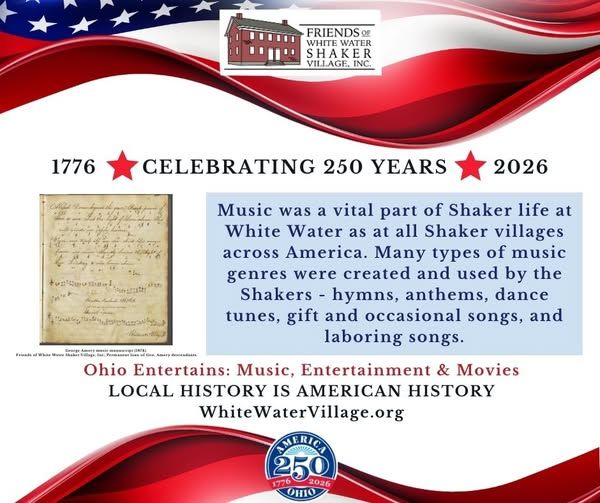
Singing and dancing were vital components of Shaker worship and everyday life. The Shakers wrote over 10,000 songs, including hymns, anthems, dance tunes, and gift, occasional and laboring songs. The well-known “Simple Gifts”, written in 1848, was written as a dancing song. Gift songs were inspired by spiritual visions. Occasional songs were songs written to mark a special occasion. Laboring songs were traditionally sung during manual labor, often having simple melodies and repetitive lyrics.
“Blessed Home”, pictured here, is one of the songs written at White Water.
April
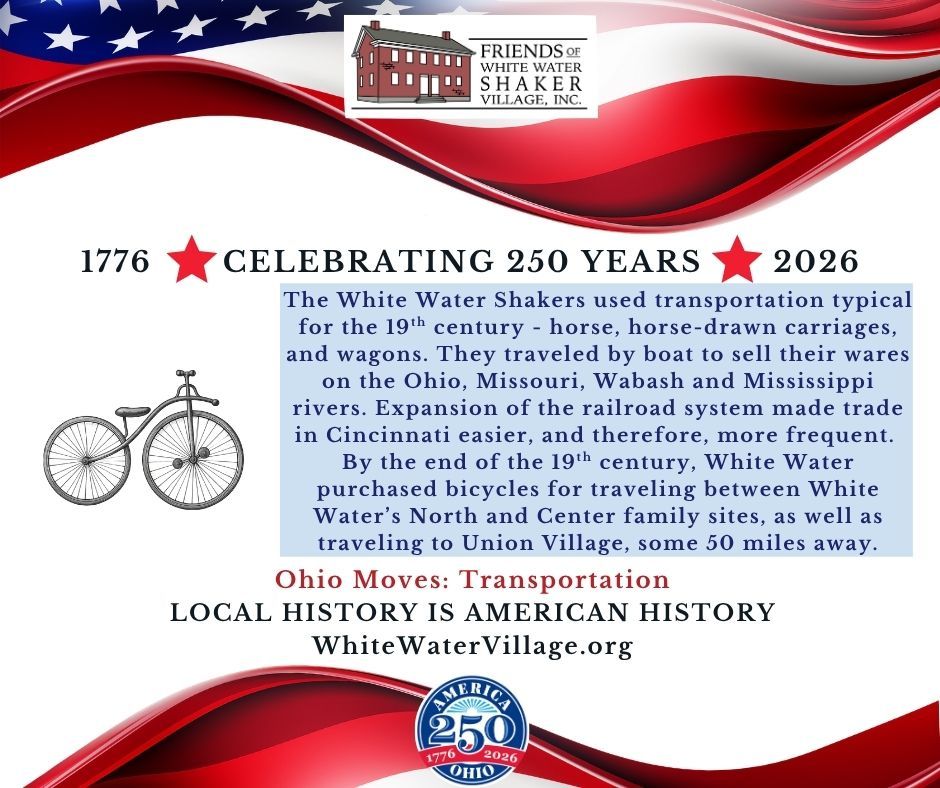
America 250-Ohio's April theme is Ohio Moves: Transportation.
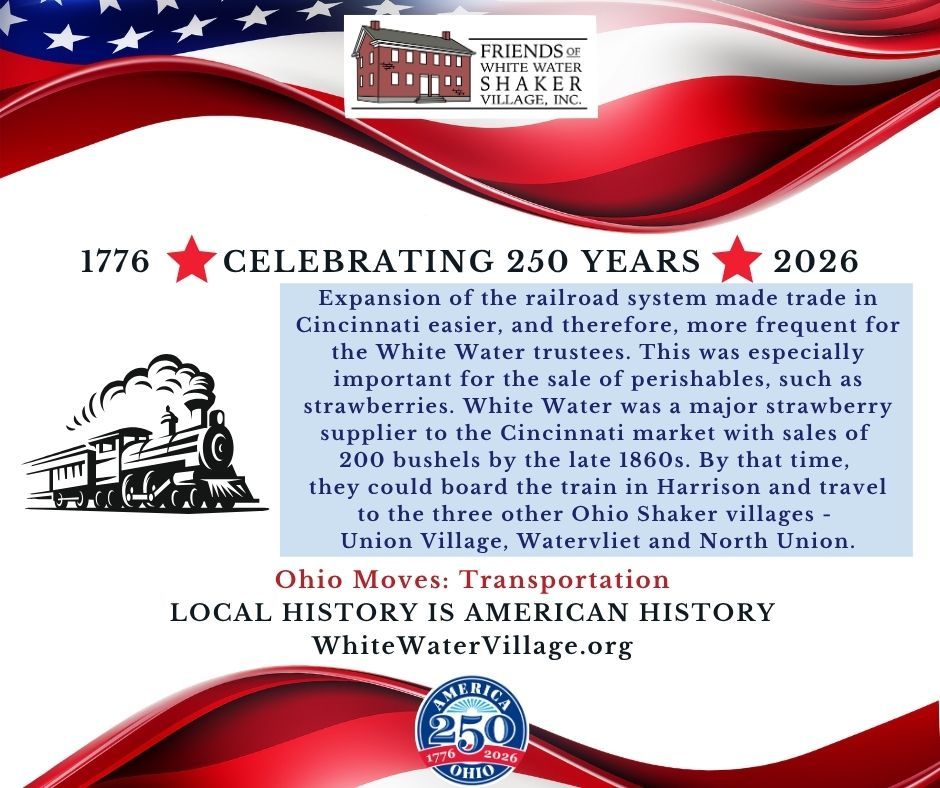
Planes, trains and automobiles... well, no planes for the White Water Shakers.
America 250-Ohio's April theme is Ohio Moves: Transportation.
May
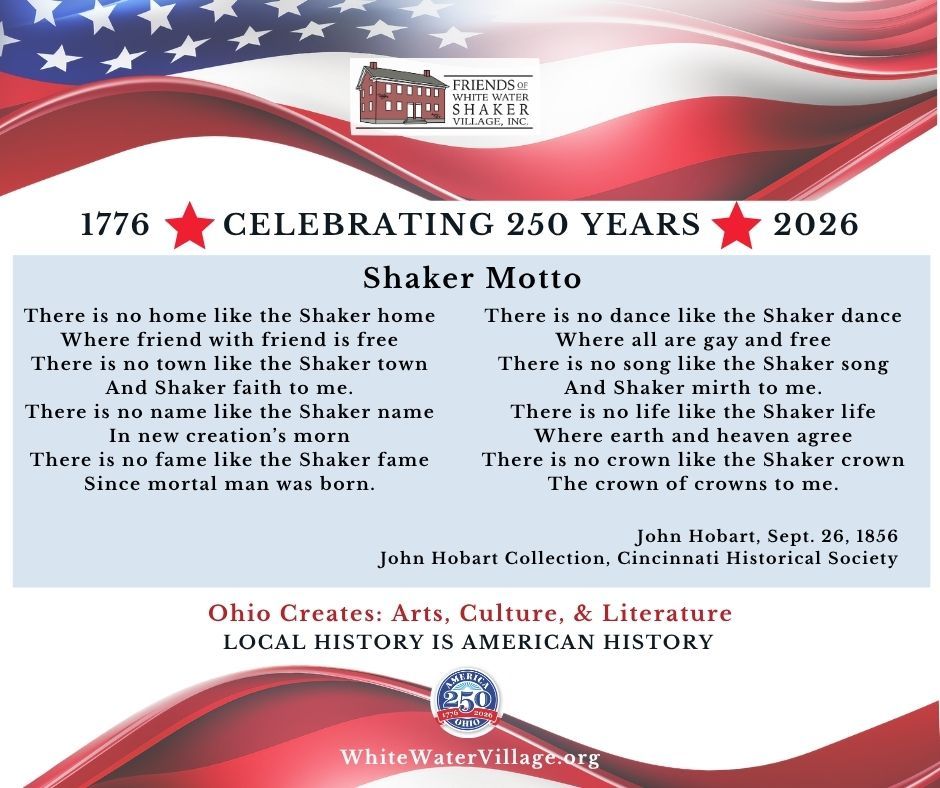
America 250-Ohio's May theme is Ohio Creates: Arts, Culture, & Literature.
The Shakers are known to have contributed to American culture in many ways – as skilled craftsmen (architecture, furniture, handicrafts) and composers of music and poetry. The Shakers believed that making something well was, in and of itself, an act of prayer.
John Hobart arrived at White Water in 1846 with his wife, Naomi, and eight of their children. Hobart was a talented poet and composed poems on a wide range of topics. At mid-century, he was one of the most prolific composers in the Shaker West. At the close of 1860, most of the Hobart family left White Water, except for John and one daughter. John died in 1866 and is buried at White Water.
June
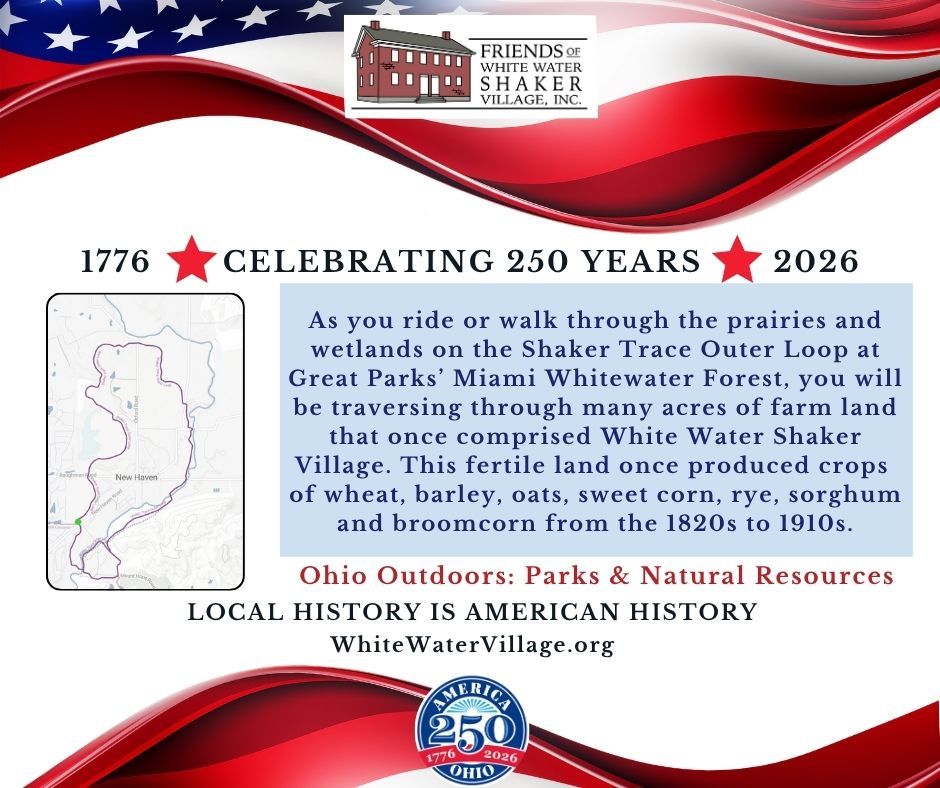
America 250 – Ohio’s June theme is Ohio Outdoors: Parks & Natural Resources.
From 1989 to 1991, Great Parks of Hamilton County acquired 733 acres of land that had once
belonged to the White Water Shakers and the remaining historic Shaker structures, expanding
Miami Whitewater Forest.
The Shaker Trace Outer Loop Trail officially opened in 1995. The fully-accessible paved trail is
7.7 miles in length and provides an opportunity for hikers and bikers to enjoy the varied
ecosystems where birds, turtles and amphibians can be found.
Much of the Shaker Trace Outer Loop Trail goes through what would have been the fields the
Shakers spent years nurturing and harvesting their crops. We invite you to think of the history
this land was a part of as you wander through this land.
America 250 – Ohio’s July theme is Ohio Gathers: Homecoming & Picnics